
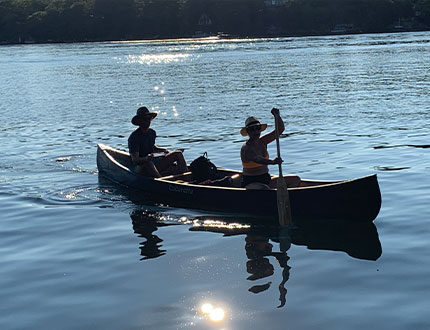
Photo Credit: Chris Kanters
What’s New

DOUG HALE MEMORIAL GOLF TOURNAMENT
AUG 8, 2026
The Charleston Lake Association will be holding its annual golf tournament at Cedar Valley Golf Club on Aug 8th. It is a significant fundraiser for the organization and a great way to see your friends and neighbors. It is a 4-person scramble, so no golfing experience is necessary.
Grab your foursome and register early as the tournament fills up.
ANNUAL GENERAL MEETING
The AGM will be held on Saturday July 25th, 2026 at 9:30 am at Holy Trinity Church on Lower Oak Leaf Road.
AED (Automated External Defibrillator)
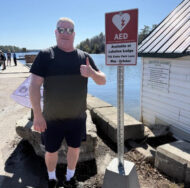
CLA has paid for and installed two AEDs at each end of the lake for public use. One is located at Lakeline Lodge (782 Cedar Park Lane) and the other is located at Whispering Pines (931 Burma Lane). They will be available from May to October.
MNR INLAND LAKE MONITORING – JUNE 8-11
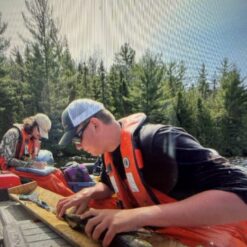
The Ministry of Natural Resources (MNR) is conducting fisheries monitoring activities on Charleston Lake. MNR science crews are setting nets to collect information on fish species. The field crews also take water samples and check for invasive species.
All MNR nets are clearly marked with yellow or orange buoys and the Ontario logo. Nets are checked and moved to a new location every day. Please do not lift the nets or buoys and avoid recreational activities between and around the buoys. The biological data collected provide MNR with valuable information about fish abundance, size, age, structure, mortality, and maturity of the types of fish in the lake.
Click for More Info: MNR_InlandLakesMonitoring_Poster

“LET’S GET THE LEAD OUT”
Lead poisoning from fishing tackle is a preventable threat that continues to harm loons and other wildlife across Ontario’s lakes and rivers.
CLA is proud to be part of the “Let’s Get The Lead Out” initiative, that is working to build awareness and support for legislative change by promoting lead-free fishing. Click on the video to learn more about lead poisoning in loons and other wildlife, directly attributed to toxic lead fishing tackle.
Download and sign the petition and help us gather signatures.
LOON NESTING CYCLE – Week 5
Finally, SUCCESS !
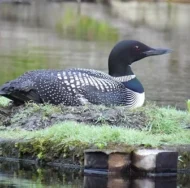
Nest 1 have proved yet again what wonderful parents they are ! This week saw both chicks hatch and the parents have done a great job in keeping them warm with cooler temperatures. Both chicks have now left the nest raft and are now on the next adventure, time on the lake !
Nest 2 continue to visit the raft with attempted mating still going on. The raccoon has visited again so I will keep an eye on things, could this year be the year we have a second attempt ?
Nest 3 has remained fairly quiet. I have been on the lake and I have seen a trio of adults which might explain why the nesting progress is slow this year. I have also seen the mink visiting which may be putting them off. This year has been a wild one with some loons being early and some later.
Nest 4 is doing well. They have been gingerly taking turns in incubating the eggs. It should be a few more weeks and hopefully we will have another successful hatching of the two eggs.
What We Do
The Charleston Lake Association (CLA) and The Charleston Lake Environmental Association (CLEA) are implementing projects to preserve and enhance our beautiful lake for future generations by…
Building a strong community by offering CLA Events
Protecting Water Quality
Promoting Boating Safety
Maintaining Healthy fisheries
Preserving the natural environment of the lake for birds and wildlife
Partnering with the wider community, townships and agencies to support our Charleston Lake Community
Protecting healthy ecosystems, including thru land conservation
Charleston Lake Facts
6,220
Acres of water surface with a shoreline length of 94 miles
100
The approximate number of islands
302
Feet of water depths
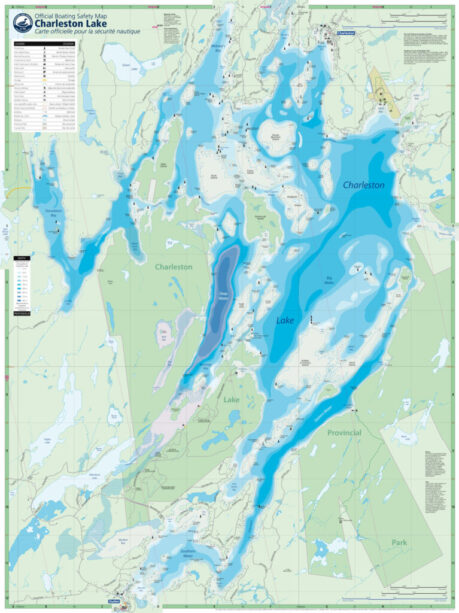
- Charleston Lake is located in South Eastern Ontario, just north east of Gananoque. The lake is carved out of the Frontenac Axis, a relatively narrow extension of the Canadian shield bedrock which dominates the landscape of Northern Ontario.
- Features a drainage basin comprising 100 square miles in area, and flows into the St. Lawrence River via the old Gananoque River. A dam is located at the outlet village which controls water flow used by the Gananoque Light and Power Company to generate hydro electric power.
- Has seven water inflows. Five of these have negligible flows and are considered seasonal streams. The two predominant inlets are Bailes Creek which drains Wilste and Eloida Lakes, and Leeder’s Creek, which drains Graham, Centre and Temperance Lakes.
- Supports a fish population comprising Lake Trout, Norther Pike, Small and Large Mouth Bass, and 14 other species of fish varying from Yellow Perch to American Eel.
- Enjoys over 200 days each year with no measurable precipitation. The average number of days of precipitation for July and August is 12 with 90 mm of rain.
- The average temperature in July and August is 26 degree high and 16 degree low.
- Has 3 public boat launches: Charleston Village, Cataraqui Conservation at Charleston Village and at the Outlet.
- Has two marinas: Kelsey’s Marina and Lakeline Lodge and Marina
- Has 75 Bouys and shoal markers